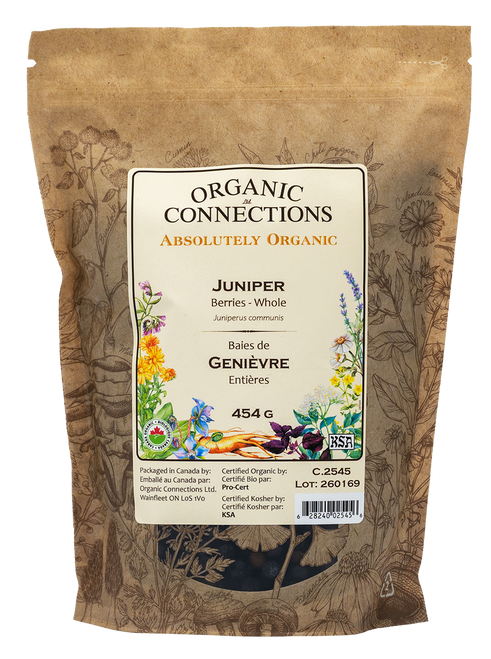
Woodland Game Changer ~ Juniper's bold aroma is like pine, resin, citrus peel, dark fruit, and pepper, with a dry bitterness that gives rich food a distinctly woodland character. Juniper has a long history in northern and central European cooking, particularly with cabbage, sauerkraut, rich meats, marinades, and slow-cooked dishes. Good Juniper berries may retain a dusty blue, wax-like bloom that develops naturally as they ripen. When lightly crushed, quality berries should release a strong, fresh aroma.
For centuries, Juniper berries have been paired with venison, wild boar, hare, and other game because their bright, piney aroma helps balance the richness of game meats with resinous freshness and subtle citrus notes. It's very traditional to use juniper berries in sausages, cured/preserved meats and similar dishes in Northern European cuisine.
Juniper berries are best known for giving gin its defining character. Their dry, resinous aroma forms the backbone of the spirit, while additional botanicals build around it. Juniper has also been used in traditional European ales, liqueurs, and farmhouse spirits.
Use Juniper berries sparingly ~ a few can season an entire pot. Lightly crush them with the flat side of a knife or a mortar and pestle before cooking to release their aromatic centre. Add them early to stews, braises, soups, brines, roasted roots, or mushrooms to bring the scent of the forest into your kitchen ~ a wild chef's best friend.
 Larger Pack Bulk (C#)


 Tea (T#)